UK energy · September 2026
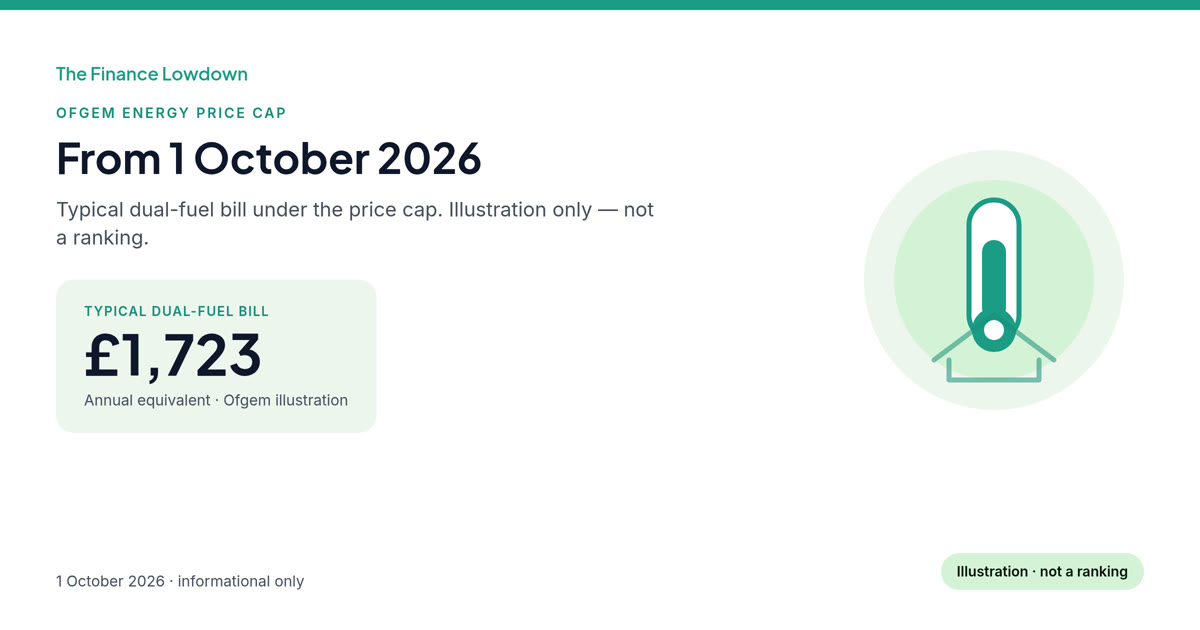
Ofgem energy price cap from 1 October 2026: typical dual-fuel bill £1,723
Last updated: 27 September 2026.
Key points
The October–December 2026 illustration
Annualised illustration at Ofgem’s medium Typical Domestic Consumption Values (2,500 kWh electricity + 9,500 kWh gas) if the quarter’s rates ran for a full year. Illustration ≠ your bill. Actual cost depends on usage, region, payment method and meter type.
| Jul–Sep 2026 | Oct–Dec 2026 | |
|---|---|---|
| Typical dual-fuel Direct Debit (annualised) | £1,663 | £1,723 |
| Change | — | +£60 (about 4%; about £5 a month if the same rates ran for a year) |
Cap period: 1 October–31 December 2026 (period 17a). Previous: 1 July–30 September 2026. Next Ofgem announcements: 25 November 2026 (January–March 2027); 23 February 2027; 26 May 2027.
The 2026 medium TDCV is lower than 2023 (electricity 2,500 vs 2,700 kWh; gas 9,500 vs 11,500 kWh). Under the old TDCV the October illustration would have been £1,935 rising from £1,862 — Ofgem publishes both for reference.
That £1,723 figure is an illustration at Ofgem’s medium Typical Domestic Consumption Values (2,500 kWh electricity + 9,500 kWh gas) if the quarter’s rates ran for a full year. It is not a fixed bill.
Actual cost depends on usage, region, payment method and meter type. Do not treat £1,723 as everyone’s bill.
Standing charge vs unit rate (GB average Direct Debit)
GB averages. Regional rates vary. Electricity standing charge is down; gas unit rate is up.
| Jul–Sep 2026 | Oct–Dec 2026 | |
|---|---|---|
| Electricity unit | 26.11 p/kWh | 26.32 p/kWh |
| Electricity standing | 57.19 p/day | 54.83 p/day |
| Gas unit | 7.33 p/kWh | 7.97 p/kWh |
| Gas standing | 29.04 p/day | 29.68 p/day |
VAT: electricity VAT is 0% from 1 October 2026 to 31 March 2027; gas stays at 5%. Ofgem: without the VAT cut, the dual-fuel illustration would be about £45 higher. Costs “cannot be compared directly to previous periods because of this change.” Gas bills rise about 8% on Ofgem’s stack; households without gas see a change of less than 1%.
Electricity VAT is 0% from 1 October 2026 to 31 March 2027. Gas stays at 5%.
Ofgem: without the VAT cut, the dual-fuel illustration would be about £45 higher. Costs “cannot be compared directly to previous periods because of this change.”
Electricity standing charge is down; gas unit rate is up. Gas bills rise about 8% on Ofgem’s stack. Households without gas see a change of less than 1%.
Who the cap applies to
The cap sets maximum unit rates and standing charges on default / standard variable tariffs (including Direct Debit, standard credit, prepayment and Economy 7). It is not a fixed total bill and does not set fixed-deal rates.
| Group | Scale (Ofgem) | Effect of this rise |
|---|---|---|
| Default / SVT tariffs | about 22 million households | Covered by the Oct–Dec 2026 maximum unit rates and standing charges |
| Fixed tariffs | about 35% (about 11 million) | Unaffected — contracted unit rates do not change with this quarterly rise |
| Northern Ireland | — | Outside Ofgem’s price cap |
Fixed deals sit outside the quarterly cap — see fixed-rate energy tariffs. Winter payments and hardship help sit alongside the cap, not instead of it — winter heating support.
About 22 million households are on default or standard variable tariffs. They are covered by the cap’s maximum unit rates and standing charges.
About 35% of households — around 11 million — are on fixed tariffs. This rise does not change their contracted unit rates. Fixed deals sit outside the quarterly cap: fixed-rate energy tariffs.
The cap is a maximum for unit rates and standing charges on default / SVT tariffs (including Direct Debit, standard credit, prepayment and Economy 7). It is updated every three months.
It is not a fixed total bill. Regional rates vary; Ofgem publishes GB averages and postcode tables.
Payment-method illustrations (medium TDCV, annualised)
| Method | Jul–Sep 2026 | Oct–Dec 2026 |
|---|---|---|
| Direct Debit | £1,663 | £1,723 (+4%) |
| Standard credit | £1,796 | £1,861 (+4%) |
| Prepayment | £1,620 | £1,678 (+4%) |
| Economy 7 Direct Debit | £1,039 | £1,046 (+1%) |
Prepayment still sits below Direct Debit via levelisation (−3% for PPM vs +0.5% for Direct Debit in the cost stack). These figures are illustrations at medium TDCV — not a supplier comparison and not a recommendation to change payment method.
Prepayment still sits below Direct Debit via levelisation (−3% for PPM vs +0.5% for Direct Debit in the cost stack).
Cap period and next dates
- Announced: 26 August 2026
- Applies: 1 October – 31 December 2026 (period 17a)
- Previous period: 1 July – 30 September 2026
- Next announcements: 25 November 2026 (January–March 2027); 23 February 2027; 26 May 2027
What sits behind the rise (Ofgem)
The wholesale allowance is up 11% and now makes up 47% of the Direct Debit stack. Ofgem points to Middle East geopolitics and gas markets: gas wholesale +13%, electricity wholesale +10%.
TDCV note
The 2026 medium TDCV is lower than 2023 (electricity 2,500 vs 2,700 kWh; gas 9,500 vs 11,500 kWh). Under the old TDCV, the October illustration would have been £1,935 rising from £1,862. Ofgem publishes both for reference.
Context (calm)
Prices remain 52% below the 2022 crisis peak, when government capped bills at £2,500 (Ofgem). Inflation-adjusted, the new cap is 7% higher than the same period in 2025 (Ofgem).
Winter payments and hardship help sit alongside the quarterly cap, not instead of it: winter heating support.
Forecasts for January–March 2027 that appear on comparison sites are predictions, not Ofgem’s locked figure for this quarter.
Paying bills from a current account: banking. Household budgeting tools: UK budgeting apps.
Important things to know
- Typical dual-fuel Direct Debit illustration: £1,663 → £1,723 (+£60 / 4%) for 1 October–31 December 2026.
- That figure is an illustration, not a fixed household bill.
- Electricity standing charge is down; gas unit rate is up.
- Electricity VAT is 0% from 1 October 2026 to 31 March 2027; gas stays 5%.
- About 22 million are on default tariffs; about 35% on fixed deals are unaffected.
October 2026 energy price cap: FAQs
What is the Ofgem energy price cap from 1 October 2026?
Ofgem announced on 26 August 2026 that the energy price cap for 1 October to 31 December 2026 rises by 4% on the typical dual-fuel Direct Debit illustration, from £1,663 to £1,723. That figure is an annualised illustration at medium TDCV. It is not a fixed household bill.
Is £1,723 my energy bill?
See The October–December 2026 illustration above.
Who does the October–December 2026 cap apply to?
About 22 million households on default or standard variable tariffs are covered by the cap’s maximum unit rates and standing charges. The cap covers Great Britain only. Northern Ireland sits outside Ofgem’s price cap.
Are fixed-rate energy tariffs affected?
See Who the cap applies to above.
What changed on standing charges and unit rates?
On GB average Direct Debit for Oct–Dec 2026 versus Jul–Sep 2026: electricity standing charge is down (57.19p to 54.83p/day); gas unit rate is up (7.33p to 7.97p/kWh). Electricity unit rises slightly; gas standing rises slightly.
What is the electricity VAT change from October 2026?
See Standing charge vs unit rate (GB average Direct Debit) above.
How do Direct Debit, standard credit and prepayment illustrations compare?
At medium TDCV annualised for Oct–Dec 2026: Direct Debit £1,723; standard credit £1,861; prepayment £1,678; Economy 7 Direct Debit £1,046. Prepayment still sits below Direct Debit via levelisation. These are illustrations, not everyone’s bill.
Does the cap cover Northern Ireland?
No. The Ofgem energy price cap covers Great Britain (England, Scotland and Wales). Northern Ireland sits outside Ofgem’s price cap.
When is the next Ofgem price cap announcement?
This period (17a) applies 1 October–31 December 2026. Next announcements: 25 November 2026 for January–March 2027; then 23 February 2027 and 26 May 2027. Forecasts on comparison sites for Jan–Mar 2027 are predictions, not Ofgem’s locked figure for this quarter.
Where do winter heating payments sit relative to the cap?
Winter payments and hardship help sit alongside the quarterly cap, not instead of it. See winter heating support for payments and help. This page does not recommend a supplier switch.
Get our weekly email
The Friday Finance Lowdown — five minutes of the money stuff worth knowing.
Free to join. See our privacy policy for how we handle your email address.